
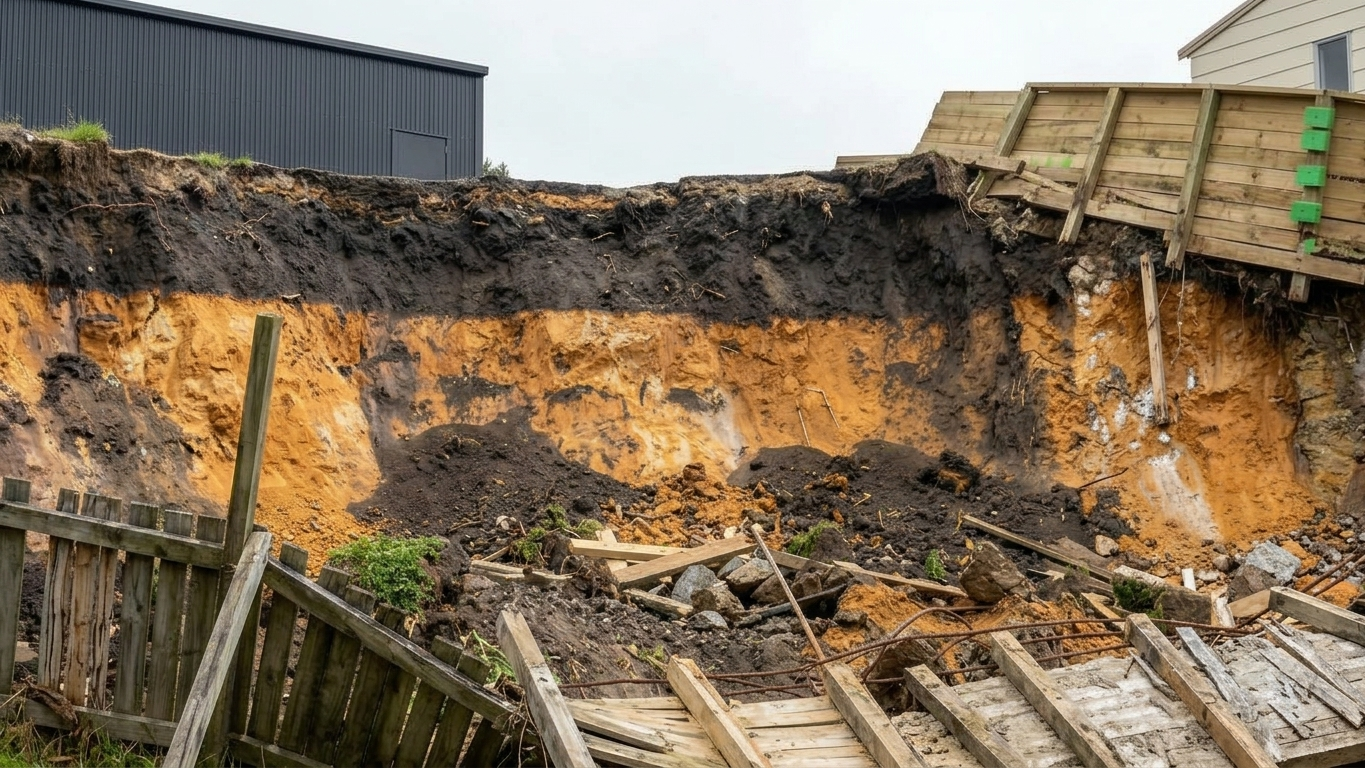
Retaining walls can be expensive structures and, when something goes wrong, the resulting damage can extend well beyond the wall itself. For builders and property owners, understanding the insurance position is important because the cover changes significantly between construction and once the structure has been completed.
1. Retaining Walls Under Construction
Accidental Damage
While a retaining wall is being built as part of a construction project it should be covered by contract works insurance. Contract Works insurance covers the insured construction work against accidental physical loss or damage during the project. Because collapse, subsidence and landslip are some of the most common and costly events during construction insurers typically want to know if the project involves substantial retaining, as this may affect the price and terms offered.
Design & Workmanship
Another big issue with retaining walls is defective design or workmanship. If a wall collapses because it was incorrectly designed or constructed, cover for the defective work itself is likely to be excluded, as there is no insurance available for rectifying defective work that is discovered during the construction phase. There should still be cover for resulting damage to other parts of the insured works.
If the builder has designed the wall, altered an engineer's design or assumed contractual responsibility for design, professional indemnity insurance needs to be considered. Builtin provides a policy specifically for builders known as “design & construct” professional indemnity. Cover is still subject to design work being done or supervised by an appropriately qualified and/or licensed person.
Liability for Damage to Third Party Property
Excavation or retaining work can remove support from neighbouring land. If this causes a neighbour's driveway, building or land to move or collapse, the contractor could face a substantial liability claim.
Public Liability insurance may respond to accidental damage to third-party property, but contractors need to check exclusions and limitations relating to vibration & removal of support. These typically have higher excesses and lower limits of cover.
Don't assume a retaining wall under 1.5 metres automatically avoids consent requirements. The Building Act exemption only applies where the wall retains no more than 1.5 metres of ground and does not support an additional load or surcharge, such as a driveway, building, parking area or sloping ground.
This can also become an insurance issue. If work required a building consent but was constructed without one, and that non-compliance contributed to the subsequent loss, it may create problems when making an insurance claim.
2. Retaining Walls Once Completed
Once the project is finished, contract works insurance ends.
For residential properties, the Natural Hazards Commission (NHC) provides some cover for retaining walls damaged by an insured natural hazard. However, this cover is limited.
Generally, an eligible retaining wall must support or protect the home, an insured related building or insured residential land and be within 8 metres of the home or on the land under or supporting your main accessway, up to 60 metres from your home. Landscaping or non-structural retaining walls are not covered just because they are located on the property.
Under the Natural Hazards Insurance Act (which replaced EQC in 2024) the value of qualifying retaining walls is based on their undepreciated value, subject to a maximum of $50,000 plus GST for all retaining walls per dwelling.
Importantly, undepreciated value does not necessarily mean the actual cost of reinstatement. It is essentially the reasonable cost of constructing a substantially similar structure as new. It does not automatically cover the additional cost of upgrading the wall to meet today's standards. Consequently, an older wall that now requires a substantially more expensive engineered solution, extensive excavation or other improvements could cost considerably more to reinstate than the NHI settlement.
Some house insurance policies provide additional cover for retaining walls, including cover beyond what NHI provides. The limits, insured events and settlement basis vary, so owners of properties with substantial retaining structures should check their policy rather than assuming they have full replacement cover.
3. Watch Out for Section 72 Notices
A particularly important issue for hillside properties (or any property at risk of a natural hazard) is a Section 72 notice on the property's title.
These notices identify land known to be affected by, or at risk from, a particular natural hazard. If subsequent damage is caused by the same type of natural hazard identified in the notice, NHC has the right to fully or partly decline the claim. That could leave an owner with little or no NHI contribution towards a damaged retaining wall or associated land damage.
Some insurers retaining wall cover is consequent on the NHC accepting the claim, so if it’s declined due to a Section 72 notice it also won’t be covered by the house insurer’s retaining wall benefit either. That could be a major uninsured problem!
Finally, liability doesn't disappear when construction finishes. If the retaining wall subsequently fails and damages a neighbour's property, questions may arise about who owned the wall, who was responsible for maintaining it, what caused the failure and whether anyone was legally liable.
In a nutshell
Retaining walls can create a large financial exposure and insurance may not cover it in whole or even in part. Whether you're building it or it is already built, make sure you understand exactly where you stand with regard to insurance cover.