
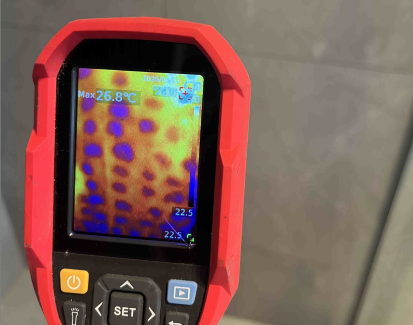
One of the most expensive defects a residential builder will face is a leaking bathroom. Ironically, many of these failures begin with a bathroom that looked perfect on handover. Hidden behind the tiles, however, is a shortcut that can turn into a six-figure liability: spot fixing (also known as dot or dab fixing).
The Problem
Industry experience suggests that up to 80% of water migration issues are associated with spot-fixed tiles. While the grout lines may appear sound, grout is not completely waterproof. Over time, moisture can penetrate through microscopic cracks and natural porosity. Where tiles have been fully bedded, there are minimal voids for water to travel. With spot fixing, however, large cavities exist behind the tiles, allowing water to accumulate, migrate and track throughout the system.
The problem doesn’t stop there. Spot fixing also creates concentrated point loads on the waterproof membrane. As the building moves or the tiles are subjected to impact, these pressure points can damage the membrane, creating another pathway for water ingress. When combined with other common failures, such as poorly detailed leak control flanges around penetrations and the omission of water stops, the result can be serious .
These risks are well recognised in industry guidance. The New Zealand Code of Practice for Internal Wet Area Membrane Systems emphasises that full adhesive embedding is critical to eliminate air voids behind tiles, and references AS 3958.1 for minimum adhesive coverage requirements in wet areas. Likewise, Building Code Clause E3 requires wet areas to manage internal moisture appropriately, and E3/AS guidance expects tiled wet areas to avoid moisture pathways that can lead to damage.
For builders, the financial risk is significant. When a bathroom leaks, the homeowner’s contract is with their builder, not the tiler. By the time the defect appears, the subcontractor may have changed businesses, become insolvent, stopped answering calls or disappeared altogether. The builder is then left organising demolition, reinstatement and often lengthy disputes, while carrying the reputational damage.
At Builtin, the most common liability claims we deal with involve leaking bathrooms. These claims are expensive, often involving multiple bathrooms in a single property. They are disruptive and increasingly difficult to insure, with some insurers tightening their underwriting or imposing exclusions because of the frequency and severity of bathroom failures.
The Solution
Fortunately, the solution is straightforward: demand better standards from your subcontractors. The Tile Association of New Zealand (TANZ) is doing excellent work lifting industry standards through its T.E.A.M (Tiling Excellence Accreditation & Mastery) training programme and best practice guide.
At a minimum, builders should engage tilers who are members of TANZ, giving them access to current technical guidance and best-practice resources. Better still, insist your tilers have completed the T.E.A.M training. One nationwide residential building company has reported a dramatic reduction in bathroom failures after making T.E.A.M training a requirement for all of its tiling subcontractors.
A tiler who has sat through their supplier’s “training” and become an approved applicator is not necessarily well trained in best practice, so don’t be fooled.
Make sure your tiler takes photos throughout the installation process, and if you notice spot fixing is occurring take steps to demand the correct practice. Failing to do so is a recipe for storing up a big problem for the future.
Also, check or enquire if the specification includes waterstops. A waterstop is an effective means of containing water to prevent it from tracking into areas it shouldn’t. A bead of silicone isn’t an effective waterstop, nor is a tile trim.
For more information read the article on the TANZ website: https://tanz.net.nz/spot-a-dot-a-dab.
A bathroom may only be as good as the work hidden behind the tiles. Choosing qualified, well-trained tilers is one of the simplest and most effective risk management decisions a builder can make.